Islamabad became Pakistan's capital in 1963, replacing Karachi. It was placed on the Potohar Plateau, next to Rawalpindi, deliberately away from the country's commercial centre but easy to reach.
The area has a long history: ancient settlements, the routes of great caravans, and the passage of figures such as Alexander the Great and Tamerlane. Today the city is known for its calm and cleanliness.
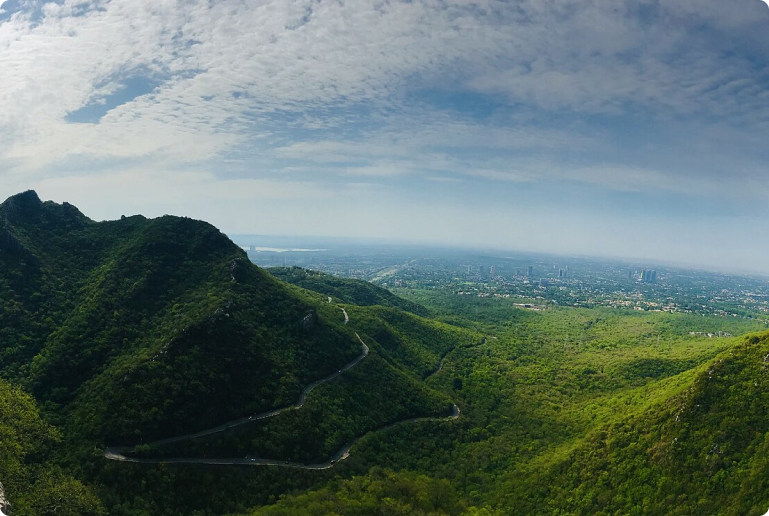
Islamabad is divided into zones for administration, diplomacy, housing, education, industry, commerce and rural areas. Against the Margalla Hills it has a healthy climate, plenty of water, and wildlife that includes wild boar and leopards.
As the country's capital, the city balances modern life with traditional values: a young nation's drive for progress alongside its cultural heritage.
Facts and figures
- Location
- 14 km north-east of Rawalpindi, on the north-eastern edge of the Potohar Plateau
- Altitude
- 457 to 610 metres
- Map reference
- 33° 49′ N, 72° 24′ E
- Rainfall
- 1,143 mm a year on average
- Humidity
- 55% a year on average
Climate
Islamabad has an unusual humid subtropical climate: hot, humid summers with a monsoon season, followed by cool winters.
Winter October to March
3° to 17°C
Summer April to September
24° to 34°C
A city of many people
- Islamabad has the most diverse population of any city in Pakistan.
- It is home to the country's largest community of expatriates and foreigners, drawn by its mild climate, green surroundings and good infrastructure.
- Travellers stop here on their way to the northern areas for trekking, hiking, adventure sports and mountaineering.
- As a growing centre of business, it attracts skilled workers from Karachi, Lahore, Quetta and other cities.
- All of Pakistan's diplomatic relations are run from Islamabad, home to the Foreign Office and the major embassies, consulates and missions.
The master plan
A commission chose a site north-east of Rawalpindi for its climate, defence needs and natural beauty.
The Capital Development Authority was formed. Doxiadis Associates drew up the master plan: a grid of sectors facing the Margalla Hills, meant to grow towards Rawalpindi and west of the Grand Trunk Road.
Islamabad became the capital. Rawalpindi and its Cantonment were taken out of the Islamabad master plan.
Revisions of the master plan were proposed, but the Federal Cabinet did not approve them.
After a Supreme Court order, the ICT zoning regulations split Zone-4 into four zones.
The Islamabad Local Government Act divided the city into 50 Union Councils, run by the Metropolitan Corporation Islamabad.
A Federal Commission began reviewing the master plan for 2020–2040. Its interim report was approved by the Federal Cabinet and notified by CDA.
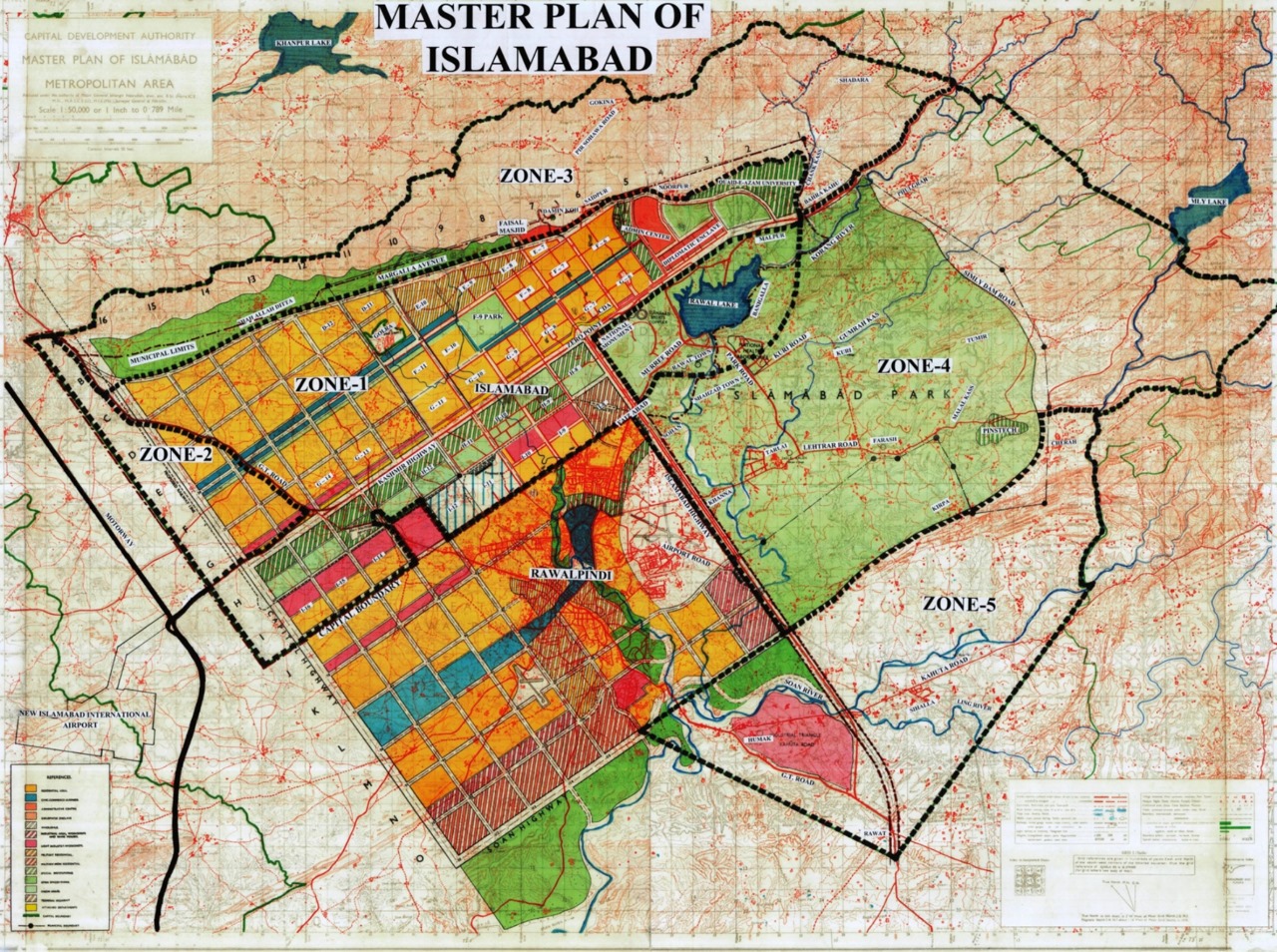 Open the full-size master plan
Master plan review documents
-
Open PDF, 2.4 MB
Interim report: Review of the Master Plan of Islamabad (2020–2040)
Prepared by the Federal Commission and approved by the Federal Cabinet. Notified under Section 51 of the CDA Ordinance, 1960.
-
Open PDF, 12 MB
Minutes of the pre-bid meeting on the review of the master plan
Meeting held on 3 November 2020.